A woman walked past me at a coffee shop in Boston last spring wearing a plain oatmeal knit dress and flat leather sandals. No logos. No hardware. Nothing that photographed loudly. And every single person at my table turned to look. That’s the whole trick. The quiet luxury dress outfit ideas women keep saving to Pinterest aren’t about spending more — they’re about removing everything that begs for attention and letting fabric, fit, and proportion do the work instead. You’ve probably felt the difference already, even if you couldn’t name it.
So let’s name it. Below you’ll find the exact formulas, fabrics, colors, and shoe pairings that make a simple dress read expensive, plus the mistakes that quietly cancel the whole effect. No vague “invest in quality” advice. Real outfits you can build this week.
What Is Quiet Luxury, Really?
Quiet luxury is a style approach that signals quality through fabric, tailoring, and restraint rather than visible logos or trend-driven detail. The clothes don’t announce a price tag. They just fit beautifully, hang correctly, and stay in your closet for a decade.
Fashion people also call it “stealth wealth” or “old money style.” Same idea, different label.
Here’s what separates it from plain minimalism: minimalism is about less stuff. Quiet luxury is about better stuff, worn simply. A cheap black tank dress with a scratchy synthetic finish is minimal. It isn’t quiet luxury.
The 5 Rules That Define the Look
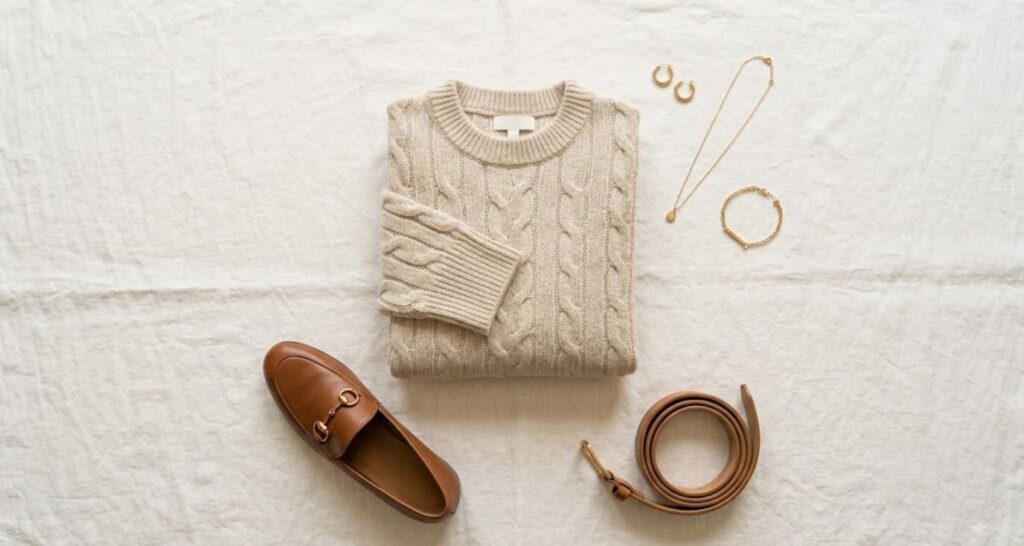
- Fabric over branding. Wool, silk, cotton, linen, cashmere, and quality viscose blends. If it shines under fluorescent light, rethink it.
- Fit that skims, never squeezes. Tailoring costs less than you think and changes everything.
- A tight color story. Three to five neutrals you actually love, rotated endlessly.
- Hardware kept quiet. Matte, small, or hidden. Zero visible logos.
- One texture moment per outfit. Ribbed knit, raw silk, suede — pick one, not four.
Read those again. Notice that only one of them involves money?
Note : Please get a complete guide about Old Money Aesthetic Dress Outfit Ideas That Look Effortless here.
Quiet Luxury Dress Outfit Ideas Women Can Build This Week
I’ve grouped these by dress silhouette, because that’s how you actually shop. Find the dress you already own, then steal the styling.
1. The Column Slip Dress + Oversized Blazer
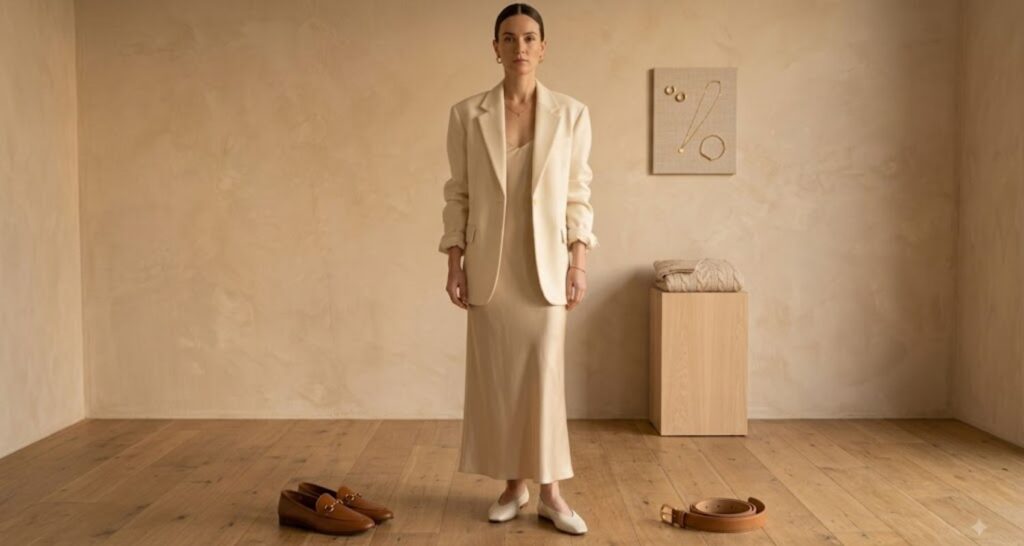
The bias-cut slip in champagne, bone, or slate gray. On its own it’s a little bare and a little bedroom-adjacent. Add a blazer with real shoulder structure and it becomes the most versatile outfit in your closet.
Keep the blazer one shade off the dress rather than matching it exactly. Cream blazer over taupe slip. Chocolate blazer over camel slip.
Shoes: a pointed flat or a low block heel. Skip the stiletto — it pushes the look toward evening and away from ease.
Where it works: dinner, gallery openings, a nice work environment, anywhere you want to look composed without trying.
2. The Fine-Gauge Knit Midi + Loafers
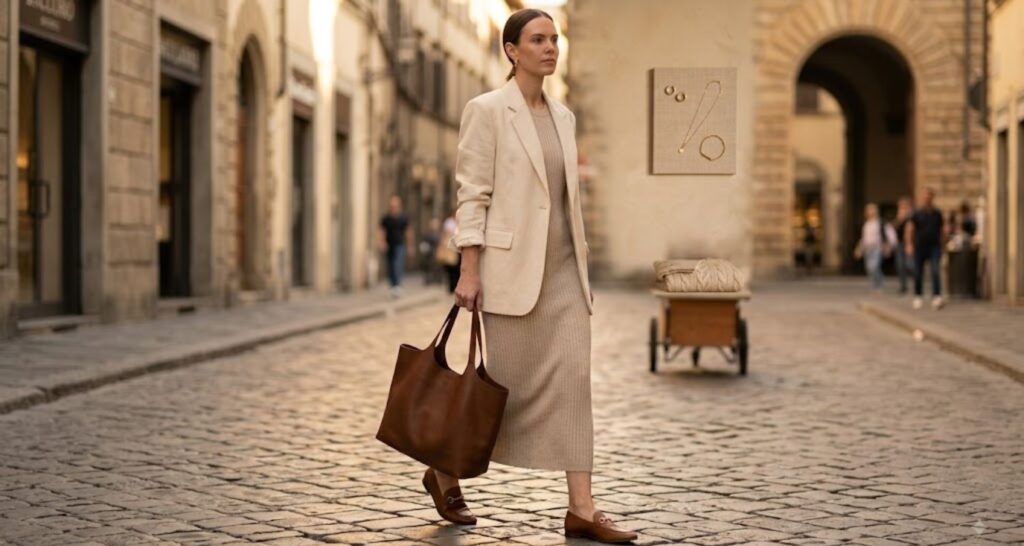
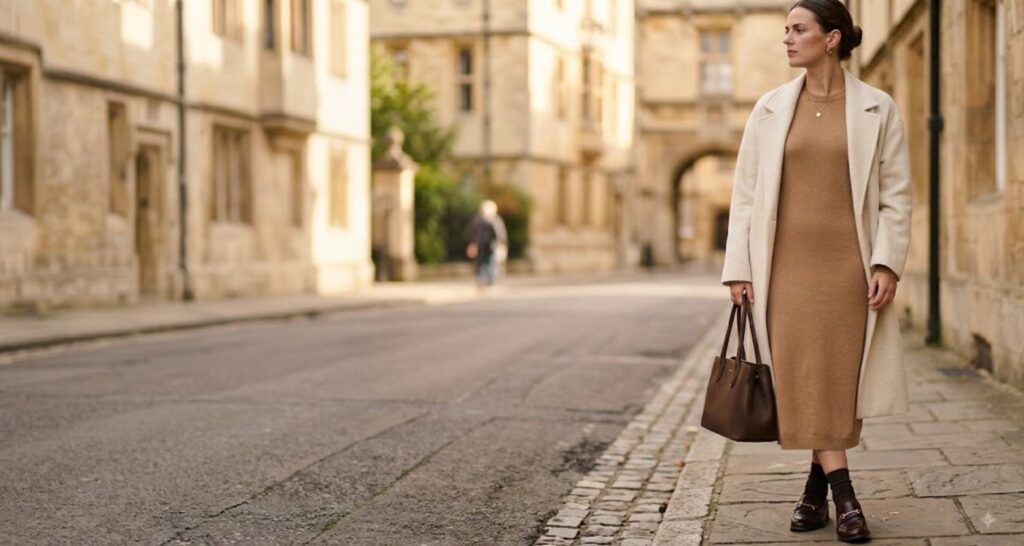
If you buy one dress this year, make it this one. A ribbed or fine-gauge knit midi in a neutral does more work than any blazer.
Wear it with leather loafers and a slouchy tote and you look like you have an interesting job in a European city. Wear it with knee boots in November and you look expensive on a Tuesday.
The detail that matters: hem length. It should hit mid-calf or lower. Anything landing at the widest part of your calf fights you.
3. The Shirt Dress, Belted and Cuffed
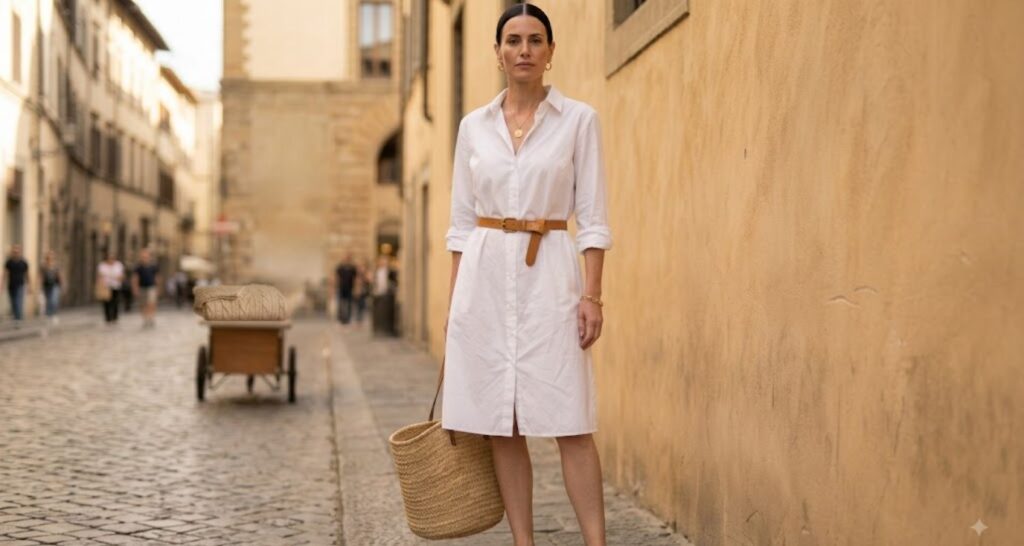
A crisp cotton or linen shirt dress feels like effort, but takes ninety seconds.
Roll the sleeves twice — never once, never three times. Belt it at the natural waist with a thin leather belt in a shade that matches your shoes. Leave the top two buttons open.
That’s it. That’s the outfit. Add a straw or canvas tote in summer and flat sandals with a real leather footbed.
4. The Sleeveless Sheath + Ballet Flats
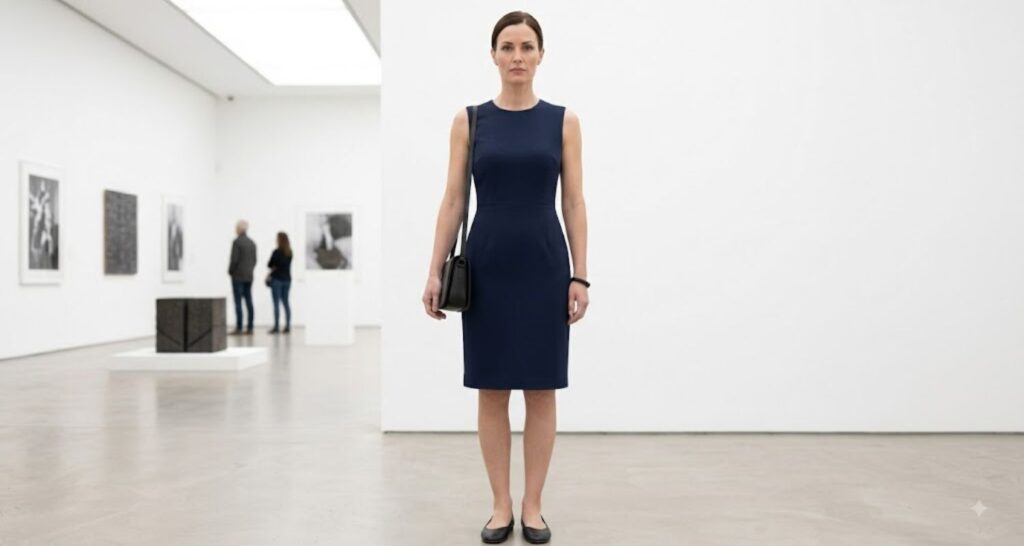
The sheath dress got a bad reputation from a decade of stiff office polyester. The updated version is soft: wool crepe, heavy cotton, or a matte silk blend that moves when you walk.
Pair it with mesh or leather ballet flats and a small structured bag. Bare legs in summer, sheer black tights in cold months.
One quiet-luxury upgrade that costs almost nothing? Have the shoulders and waist taken in by a tailor. A $60 alteration on a $90 dress reads better than a $400 dress off the rack.
5. The Long Cardigan Over a Slim Dress
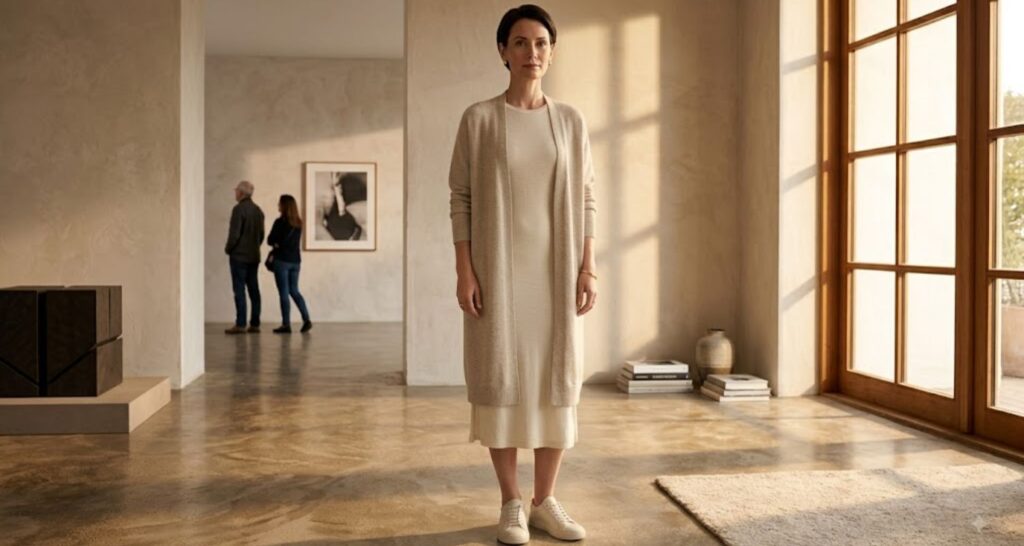
This is the outfit for days you don’t want to think. A slim jersey or knit dress underneath, a long cardigan in cashmere or merino over it, and flat leather sandals or sneakers in bone white.
Tonal is your friend here. Oatmeal on cream, gray on gray, camel on chocolate.
The cardigan should be long enough to hit below the hip. Cropped cardigans over long dresses chop you in half.
6. The Trench Coat Formula
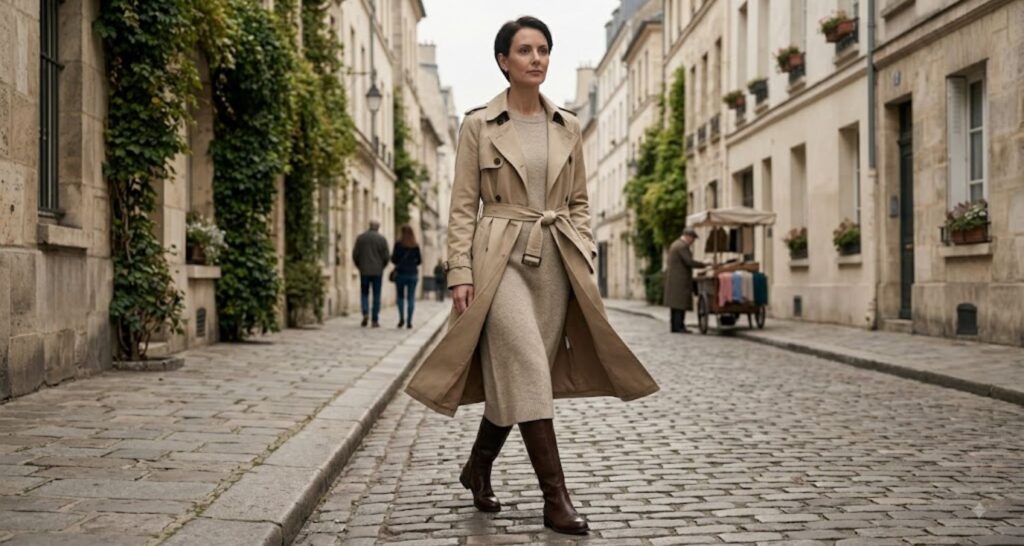
Any dress plus a good trench equals instant polish. It’s almost unfair.
Choose the trench in stone, khaki, or black, and size up slightly so it drapes rather than pulls. Belt it loosely or knot it — never buckle it tight.
Underneath: a knit dress, a slip, a shirt dress, doesn’t matter. The coat carries the outfit.
7. The All-Black Dress, Done Right
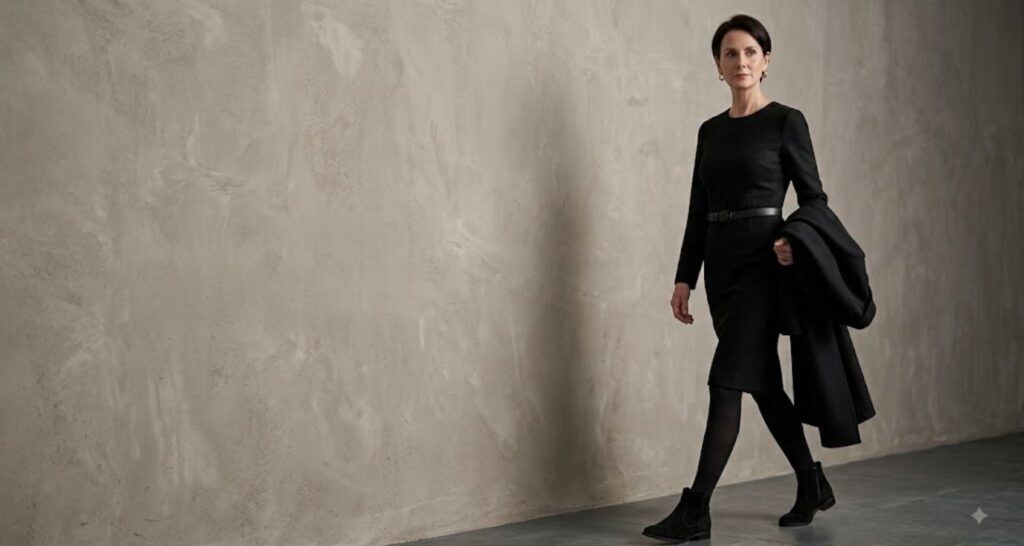
Black reads cheap faster than any other color because it shows fabric quality mercilessly. The fix is texture and finish.
Look for matte black in wool, crepe, or thick cotton — not glossy poly. Then break the flatness with one different material: suede boots, a leather belt, a wool coat, gold earrings you never take off.
Black dress, black tights, black boots, black coat, and one small gold detail. Timeless.
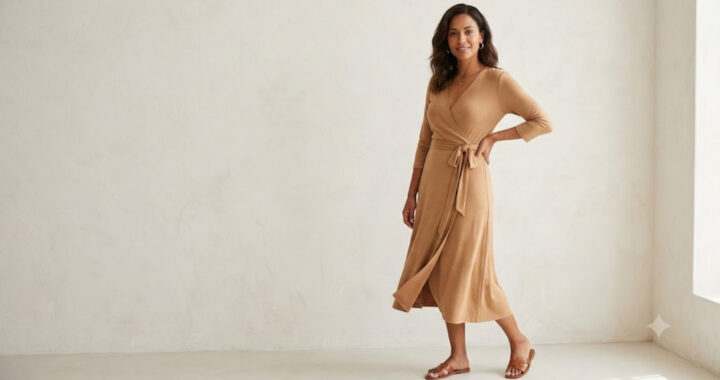
8. The Wrap Dress in Silk or Viscose
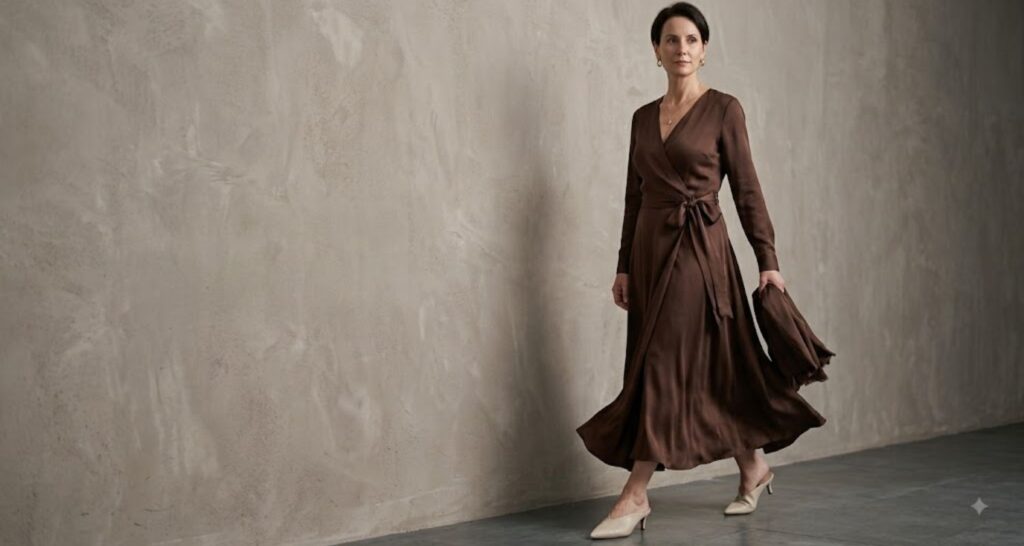
The wrap flatters more body types than almost any other cut, which is why it’s stayed in rotation since the ’70s.
For a quiet-luxury read, choose solid colors or the smallest possible print — think a fine stripe or a tonal dot. Bold prints pull you toward “statement” territory.
Pair with a slim heel or a pointed mule, and keep jewelry to one piece.
9. The Summer Linen Dress + Real Leather Sandals
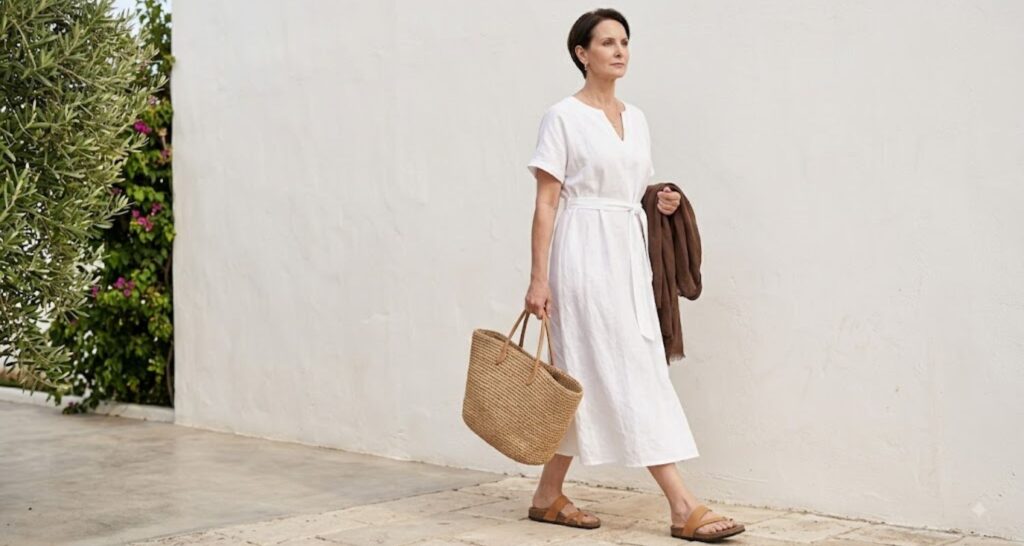
Linen wrinkles. That’s not a flaw, it’s the point — creased linen signals real fiber content the way plastic-smooth fabric never will.
Go for a relaxed midi in white, ecru, sand, or navy. Add flat leather sandals with a molded footbed and a woven bag.
Don’t fight the wrinkles. Just don’t wear it to a job interview.
10. The Sweater Dress with Knee-High Boots
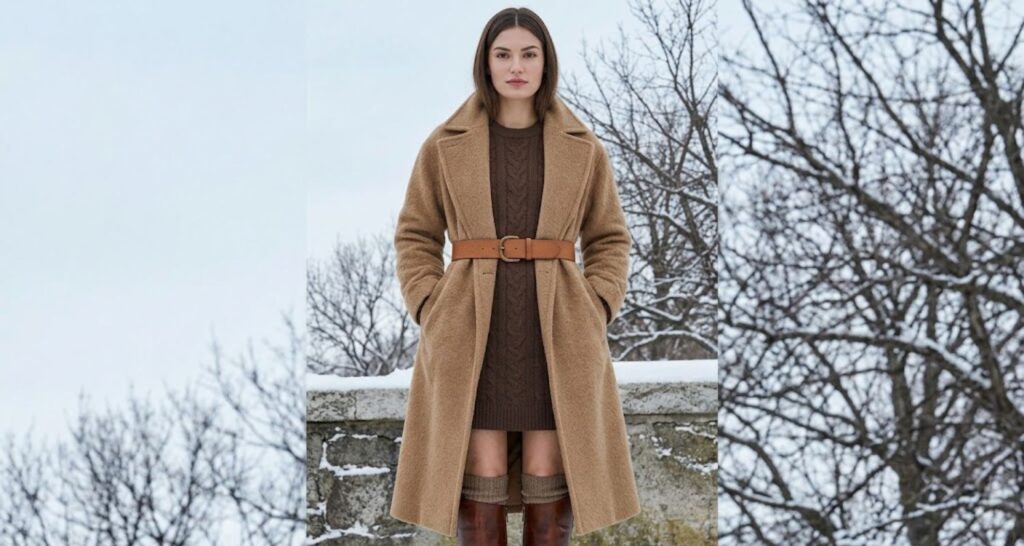
Cold-weather uniform. Merino or cashmere-blend sweater dress, tall boots in brown or black leather, and a wool coat that’s longer than the dress.
Length rule: your coat should always be longer than your hemline, or the proportions collapse.
A leather belt over the coat sharpens the whole thing in two seconds.
Note : Get the best tips on Coquette Style Dress Outfit Ideas here.
Build Any Quiet Luxury Outfit in 5 Steps
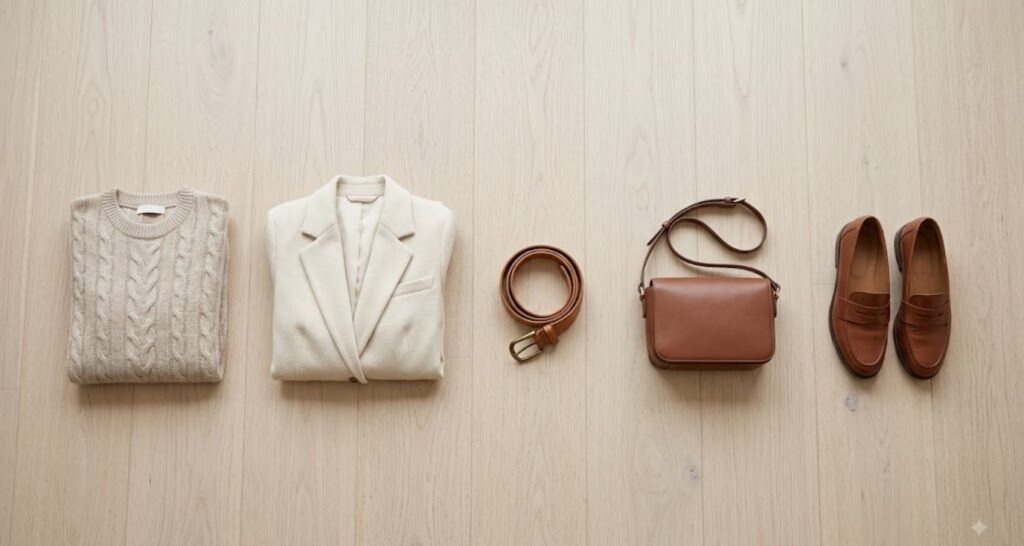
Use this when you’re standing in front of your closet at 7:40 a.m.
- Start with the dress in the best fabric you own. Not the trendiest. The best-feeling one.
- Choose one neutral third layer — blazer, trench, cardigan, or long coat.
- Match your leather. Belt, bag, and shoes should sit in the same family, not necessarily identical.
- Add exactly one piece of jewelry you’d wear every day: a gold hoop, a signet ring, a thin chain.
- Remove one thing before you leave. Almost always the right call.
That last step is the one people skip. Try it for a week.
The Fabric Guide: What Actually Reads Expensive
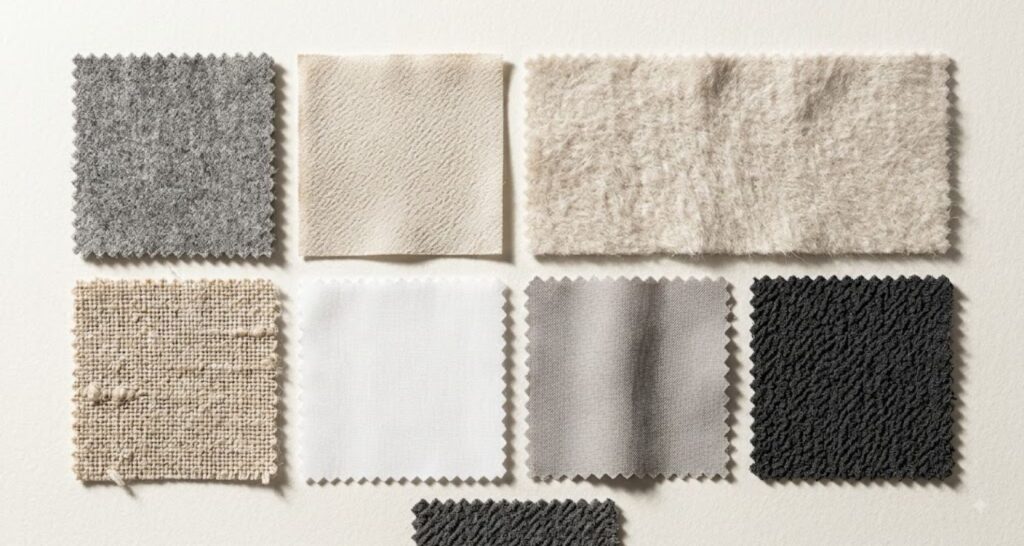
| Fabric | Why It Works | Best For | Watch Out For |
|---|---|---|---|
| Merino wool | Drapes, resists odor, holds shape | Sheath and sweater dresses | Thin, itchy low-grade wool |
| Silk (crepe or charmeuse) | Fluid movement, subtle sheen | Slip and wrap dresses | Water spots; dry-clean cost |
| Cashmere blend | Softness with more durability than pure | Knit midis, cardigans | Pilling on cheap blends |
| Linen | Breathability, honest texture | Summer midis, shirt dresses | Deep wrinkling by midday |
| Heavy cotton poplin | Crisp structure, holds a collar | Shirt dresses | Stiffness before washing |
| Viscose/lyocell blends | Silk-like drape at lower cost | Everyday dresses | Stretching out over time |
| Wool crepe | Matte finish, no shine | Sheaths, tailored dresses | Heavier weight in summer |
Quick shopping test: hold the fabric up to a window. If light passes through unevenly and the weave looks sparse, put it back. If it feels cool and dense in your hand, it’ll photograph and wear better.
The Color Palette That Makes Everything Match
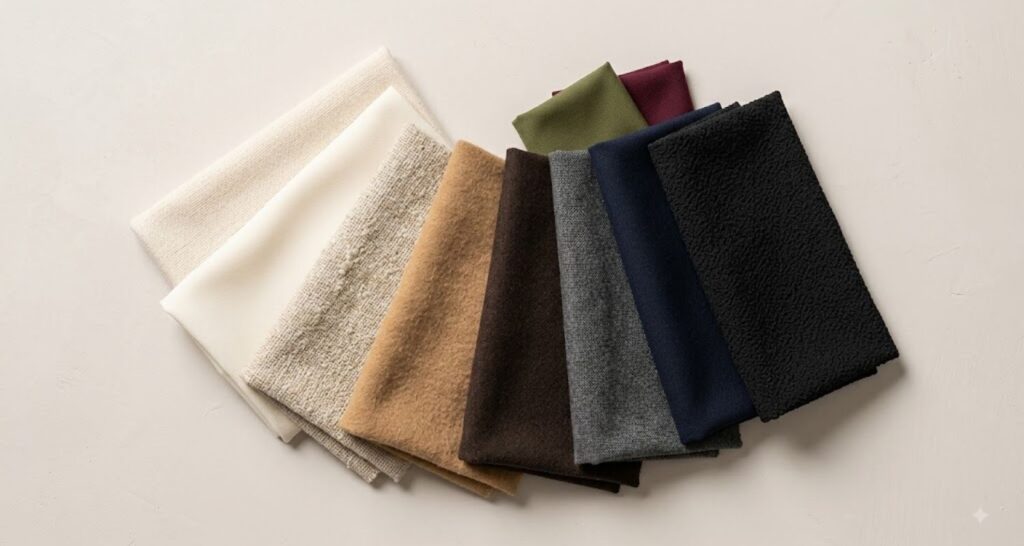
Quiet luxury lives in a narrow lane, and that’s exactly why it works. Fewer colors means more outfits.
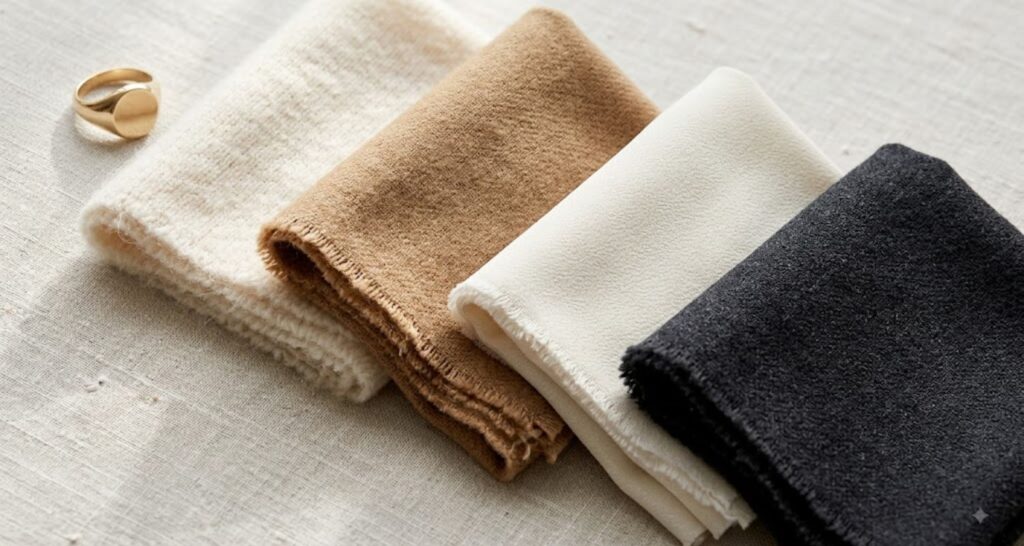
Core neutrals: cream, ivory, oatmeal, camel, chocolate brown, charcoal, navy, black.
Supporting shades: olive, slate blue, burgundy, dusty sage.
Skip for now: neon anything, high-contrast prints, heavy pattern mixing.
Here’s why this matters more than any single garment. When your dresses, coats, and shoes all live in the same eight-color family, every piece works with every other piece. A closet of thirty items suddenly produces a hundred outfits.
Ask yourself: how many things in your closet currently go with only one other thing? That’s the real cost of a wardrobe, and nobody puts it on the price tag.
Note : Best guide about Sneakers With Dress Outfit Ideas Women Love here.
Accessories: Where Most Outfits Go Wrong
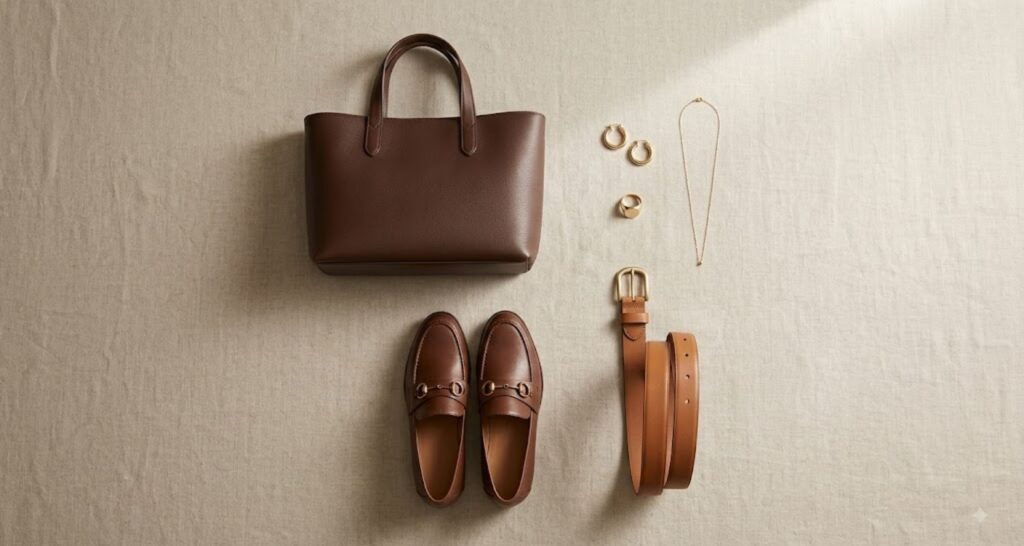
Accessories are the fastest way to break the quiet-luxury effect. One loud bag undoes a perfect dress.
Bags
Structured leather in brown, black, cream, or burgundy. No visible branding. No hardware that catches light from across a room.
A medium-size tote and one small shoulder bag cover roughly ninety percent of your life. If you’re building slowly, buy the tote first.
Shoes
Leather loafers, pointed flats, low block heels, tall boots, and simple leather sandals. That’s the list.
Sneakers can work, but only clean minimal leather ones in white or bone — not chunky running shoes.
Jewelry
Gold or silver, pick one and commit. Small hoops, a signet ring, a thin chain, a simple watch. Wear the same pieces daily until they feel like part of you.
The woman in the Boston coffee shop wore exactly two pieces of jewelry. I remember, because there was nothing else competing for my attention.
Belts
Real leather, matte buckle, and ideally coordinated with your shoes. A good belt costs $80 and lasts fifteen years. A bad one announces itself immediately.
Quiet Luxury on a Real Budget
Let’s be honest about something. Most of the “old money style” content online quietly assumes a $2,000 clothing budget, and that’s not most people.
You don’t need it. Here’s where the money actually goes furthest:
Spend more on: your coat, your shoes, and one exceptional knit dress. These three items get seen constantly and show wear immediately.
Spend less on: slip dresses (viscose versions drape beautifully), shirt dresses, and basic tees for layering.
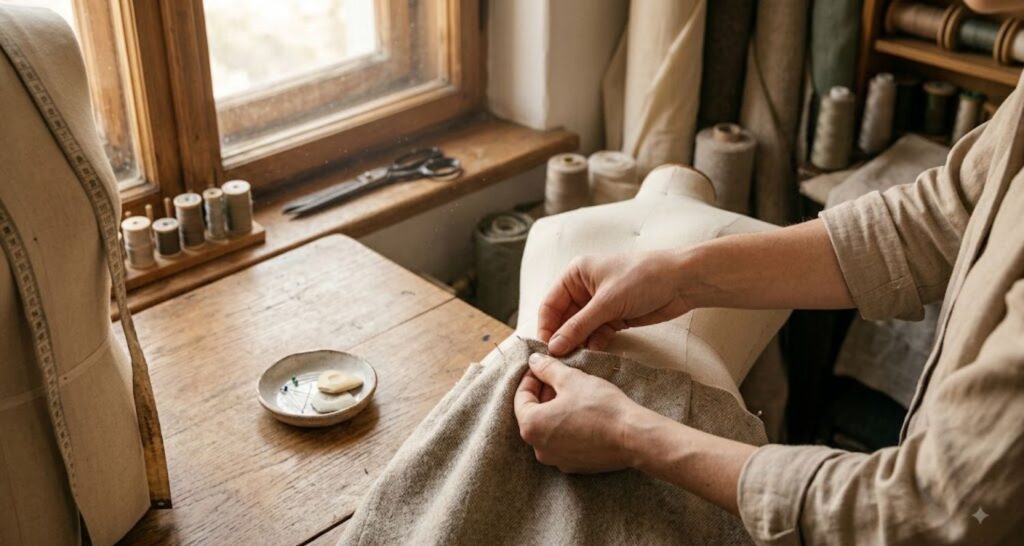
Spend almost nothing on: tailoring — and yet it changes more than any purchase. Hemming a dress to your exact length runs $20 to $40 in most U.S. cities. Taking in a waist runs $30 to $60.
I’ve watched a $45 thrifted wool dress, hemmed two inches and taken in at the waist, outperform designer pieces at the same dinner table. Fit is the luxury signal. Everything else is secondary.
Where to shop secondhand: consignment sites and local resale stores are full of wool, silk, and cashmere from brands that made things properly ten years ago. Search by fabric, not by brand name.
Season-by-Season Styling
Spring
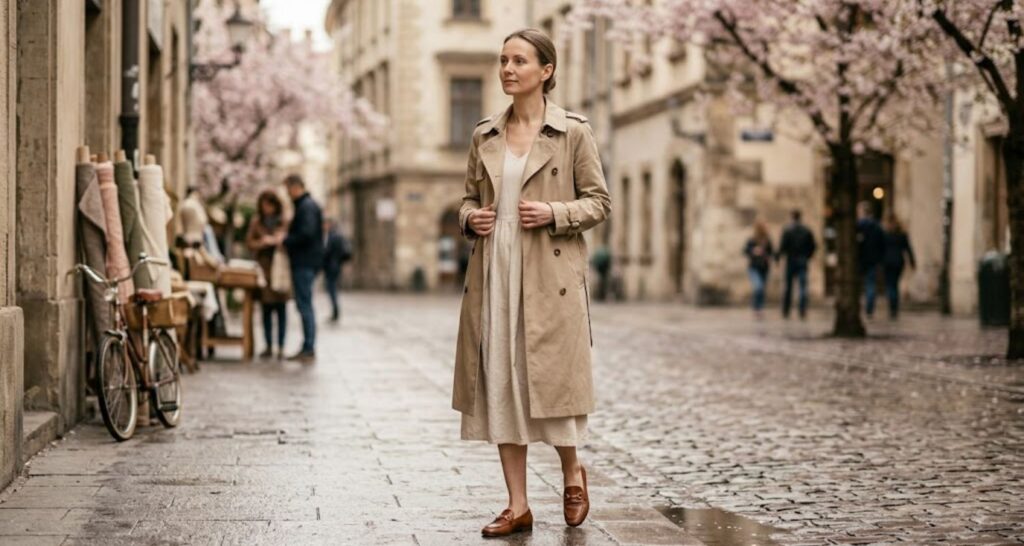
Trench coat, cotton or lightweight knit dresses, and a loafer or ballet flat. Bare ankles the second it hits 60 degrees.
Add a lightweight scarf in a solid neutral if mornings are still cold.
Summer

Linen and cotton midis, real leather sandals, woven bags. Keep the palette pale — white, ecru, sand, faded navy.
A relaxed silhouette beats a tight one in July, both for comfort and for the look.
Fall

The strongest season for this style. Knit midis, sweater dresses, tall boots, wool coats in camel or charcoal.
Layer a fine turtleneck under a sleeveless dress. It’s a small move with a big return.
Winter

Heavier knits, opaque tights, a long wool coat, and leather gloves. Tonal dressing carries winter — chocolate on chocolate, gray on gray.
Your coat is doing most of the visible work from December to March. Make it the best piece you own.
Six Mistakes That Break the Look
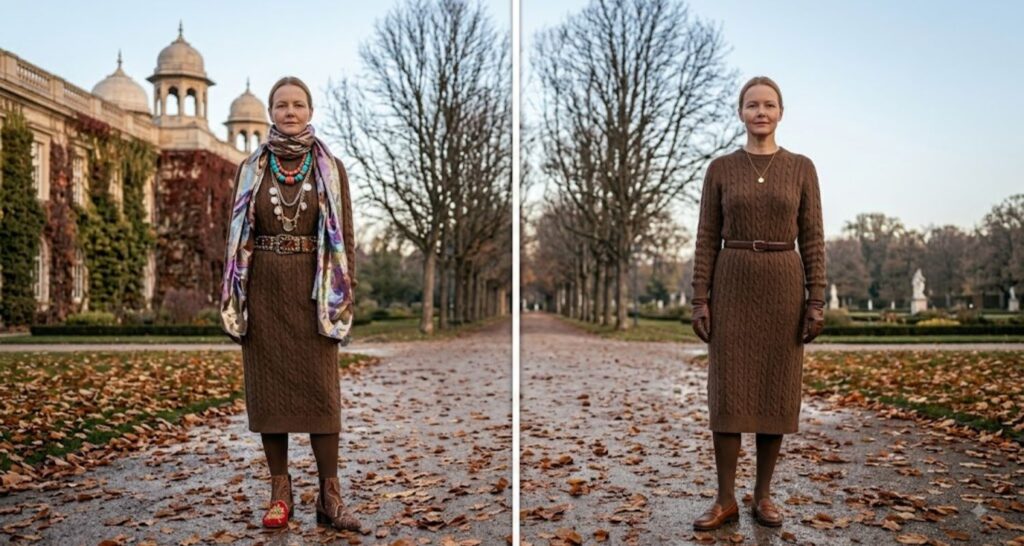
Even a great dress can go sideways. Watch for these:
- Over-accessorizing. Three necklaces, a statement bag, and printed shoes cancel each other out.
- Shiny synthetics. The single fastest tell. Matte finishes almost always read better.
- Ill-fitting shoulders. On blazers and structured dresses, the shoulder seam should sit at your actual shoulder bone.
- Visible logos. Even small ones. The whole idea is not needing to say it.
- Trend-chasing details. Cutouts, oversized buckles, dramatic sleeves — beautiful, but a different aesthetic.
- Wrong hem length. Mid-calf or below for midis; just above or at the knee for sheaths. The zone between knee and mid-calf is unforgiving on most people.
None of these require money to fix. They require noticing.
Quiet Luxury vs. Old Money vs. Minimalism
People use these interchangeably. They’re not the same.
| Style | Core Idea | Typical Palette | Key Signal |
|---|---|---|---|
| Quiet luxury | Quality without logos | Cream, camel, navy, black | Fabric and fit |
| Old money | Heritage and tradition | Navy, white, forest green | Classic silhouettes, preppy details |
| Minimalism | Fewer, simpler pieces | Black, white, gray | Clean lines, low ornament |
You can overlap all three. A cream cashmere dress with a navy blazer sits comfortably in every column.
The practical difference: old money leans preppy and reference-heavy, minimalism can be austere and inexpensive, and quiet luxury specifically centers material quality.
Frequently Asked Questions
What makes a dress look quiet luxury?
Fabric quality, precise fit, and a neutral color do almost all of it. Look for natural fibers like wool, silk, cotton, or cashmere in matte finishes, with no visible logos or flashy hardware. A well-hemmed dress in oatmeal or navy reads more expensive than a branded piece that doesn’t fit correctly.
What colors are best for quiet luxury outfits?
Stick to cream, ivory, oatmeal, camel, chocolate brown, charcoal, navy, and black as your foundation. Add olive, burgundy, or slate blue as supporting shades. A narrow palette means every piece coordinates with every other piece, which multiplies your outfit count without adding closet clutter.
Can you do quiet luxury on a budget?
Absolutely. Prioritize spending on a coat, shoes, and one excellent knit dress, then buy simpler pieces affordably. Tailoring is the biggest return per dollar — a $30 hem or a $50 waist adjustment transforms how a dress hangs. Secondhand shopping filtered by fabric content also stretches a small budget significantly.
What shoes go with quiet luxury dresses?
Leather loafers, pointed flats, ballet flats, low block heels, knee-high boots, and simple leather sandals cover nearly every situation. Choose brown, black, bone, or burgundy leather with minimal hardware. Avoid chunky sneakers, embellished heels, and anything with visible branding, since footwear breaks the look faster than any other item.
Is quiet luxury only for slim body types?
Not at all. The style relies on fit and fabric, not size, so it adapts to any body. Choose silhouettes that skim rather than cling, pay attention to hem length relative to your calf, and use tailoring to adjust waist and shoulder placement. Well-fitted clothing flatters every shape.
How many dresses do you need for a quiet luxury wardrobe?
Four to six well-chosen dresses handle most wardrobes. A knit midi, a slip dress, a shirt dress, a sheath, and one seasonal linen or sweater dress cover work, weekends, and evenings. Rotating layers — a blazer, trench, cardigan, and coat — multiply those few dresses into dozens of distinct outfits.
Start With One Dress, Not Thirty
You don’t need to rebuild your closet. Pick the best-quality dress you already own — the one that feels good in your hand — and try one formula from this list tomorrow.
Then notice what happens. Notice how you stand differently in something that fits. Notice how much easier getting dressed becomes when your shoes, belt, and bag already agree with each other.
The quiet luxury dress outfit ideas women return to year after year survive because they’re built on things that don’t expire: good fabric, honest fit, restrained color, and one piece of jewelry you never take off. Trends will keep arriving and leaving. A well-cut camel knit dress will still be working in 2036.
Buy less. Hem what you own. Wear it constantly.
That’s the whole strategy.